Seven tools now claim to run your Google Ads account with AI, and only a handful actually adjust bids, budgets, or targeting without you touching the dashboard daily. Admiral wins overall for small business owners who want campaigns built and managed without hiring an agency, Optmyzr wins for agencies juggling multiple accounts, and Google's native automation wins for anyone who doesn't want a separate tool.
- Admiral tops this list of AI Google Ads management tools for owners who want campaigns managed without an agency in 2026.
- Google Performance Max and Smart Bidding provide native automation inside Google Ads.
- Optmyzr fits agencies managing multiple client accounts; Adzooma suits marketers running campaigns across three advertising networks.
- Revealbot and Madgicx support teams that run Meta ads alongside Google Ads in 2026.
Why this matters
Manual bid adjustments and audience testing once consumed hours of account-management time. In 2026, software can handle more of that work, but the gap between tools that manage campaigns and tools that merely display recommendations remains wide.
A small business owner does not have time to study the Google Ads recommendations tab every morning. The right AI Google Ads management tool should make useful decisions, explain those decisions clearly, and leave a record you can review. That is the standard applied to all seven options below.
What makes the best AI Google Ads management tool
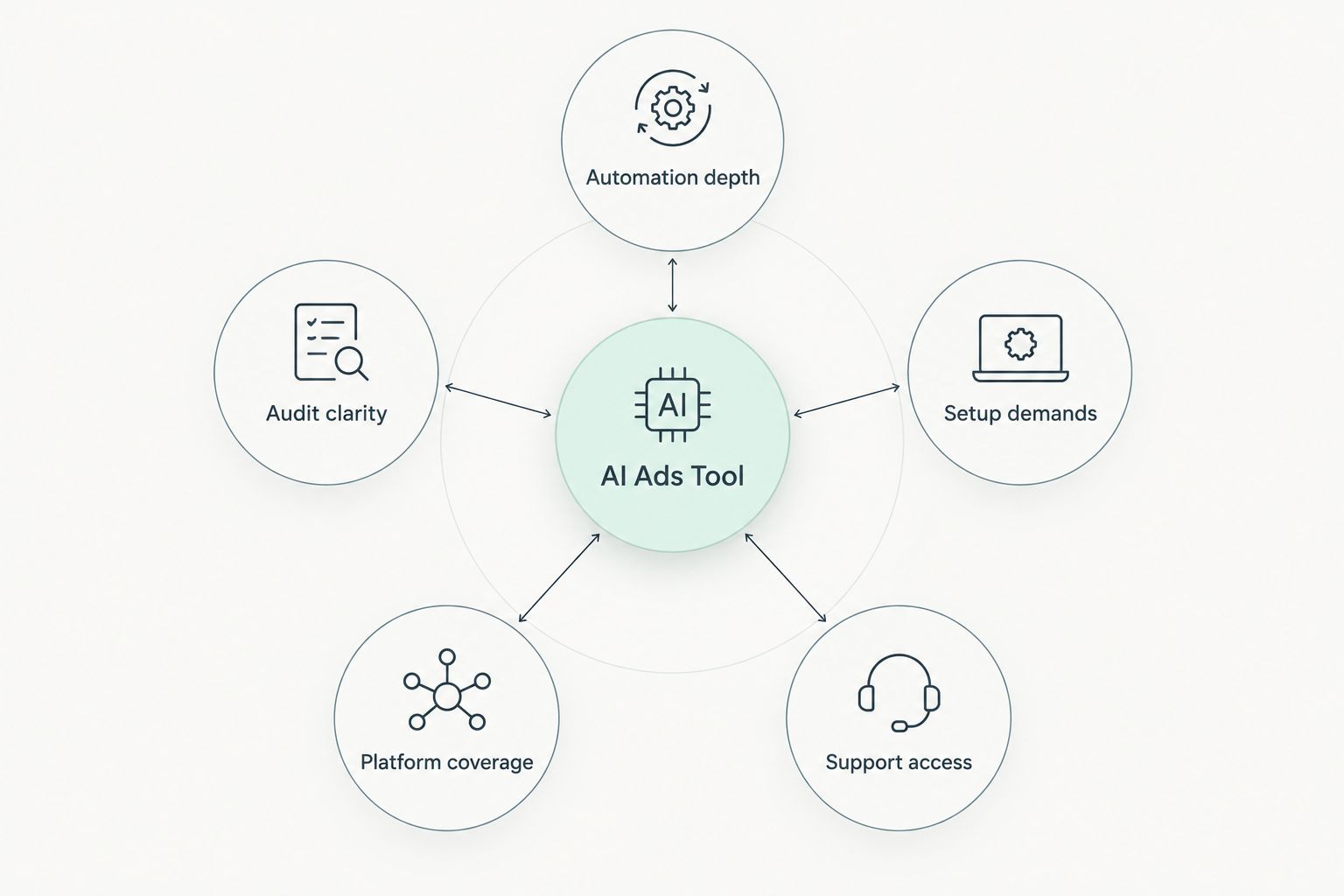
- Automation depth — does it adjust bids and budgets, or only flag issues for manual review?
- Audit clarity — can a non-specialist understand what changed and why?
- Setup demands — how much configuration is required before the software can help?
- Platform coverage — does it manage Google Ads and Meta Ads from one login or focus on one network?
- Support access — can you get help when automation produces an unexpected result?
- Reporting quality — does the tool connect campaign changes to business goals in understandable language?
AI Google Ads management tools at a glance
| Tool | Best for | Standout feature | Key limitation |
|---|---|---|---|
| Admiral | Small business owners who want ads managed without an agency | Google Ads and Meta audit, planning, and management in one platform | Less suitable for specialists who want to control every setting manually |
| Google native AI | Advertisers who want automation inside Google Ads | Smart Bidding and Performance Max are integrated with the advertising platform | Limited visibility into the reasons behind some automated decisions |
| Optmyzr | Agencies and consultants managing client accounts | Rules, scripts, and bulk account actions | Requires working knowledge of Google Ads structure |
| WordStream by LocaliQ | Local businesses seeking software and human support | Campaign recommendations paired with managed-service options | Less focused on autonomous campaign management |
| Adzooma | Marketers using Google, Microsoft, and Meta advertising | One dashboard for multiple advertising networks | Many recommendations still require manual review |
| Revealbot | Teams that want custom rules across Google and Meta | User-defined automation triggered by campaign metrics | Requires the user to define the operating logic |
| Madgicx | Ecommerce teams focused primarily on Meta advertising | Creative and audience automation with Google Ads support | Google Ads is not its primary focus |
1. Admiral: best for small business owners without an agency
Admiral audits an existing Google Ads or Meta account, creates a plan, and manages campaigns. It is designed for small business owners who want ads built and optimized without hiring a traditional agency.
Admiral pros:
- Combines auditing, planning, and ongoing management in one platform
- Serves business owners rather than agency account managers
- Covers both Google Ads and Meta campaigns
Admiral cons:
- Not designed for advertisers who want to adjust every bid manually
- Businesses that only need reporting may not need its broader management scope
Best for: small business owners who want Google Ads and Meta campaigns managed without a traditional agency.
Verdict: Buy if you want one AI Google Ads management tool to cover the workflow from audit through ongoing optimization in 2026.
2. Google native AI: best for built-in automation
Google Ads includes machine-learning systems such as Smart Bidding and Performance Max. These systems optimize campaigns toward the conversion goals configured in the account without requiring another platform.
Google native AI pros:
- Works directly inside Google Ads
- Uses Google campaign and auction data
- Supports automation across Google's advertising inventory
Google native AI cons:
- Some automated decisions provide limited diagnostic detail
- Campaign success still depends on correct conversion tracking and goal selection
Best for: advertisers who want automation contained within their Google Ads account.
Verdict: Hold as the starting point, then add an independent management layer when you need clearer auditing or cross-platform management.
3. Optmyzr: best for agencies managing client accounts
Optmyzr provides rule-based scripts, account checks, and bulk actions for paid-search teams. Its workflow is geared toward practitioners managing several accounts rather than an owner learning advertising from scratch.
Optmyzr pros:
- Supports repeatable rules across client accounts
- Provides bulk actions for campaign-management teams
- Includes reporting features intended for agency workflows
Optmyzr cons:
- Requires Google Ads knowledge to configure effectively
- Its agency-oriented controls can overwhelm a single-account owner
Best for: agencies and consultants managing several Google Ads accounts.
Verdict: Buy if account management is your job; Skip if you are a small business owner seeking hands-off guidance.
4. WordStream by LocaliQ: best for human support
WordStream is associated with LocaliQ and offers campaign-assessment and advertising-management services. The combination suits businesses that want software insights but still value contact with a person.
WordStream pros:
- Presents recommendations in language intended for non-specialists
- Connects software analysis with service options
- Has a long-standing presence in paid-search education
WordStream cons:
- It is less focused on autonomous campaign management than newer AI-led platforms
- The service component may be unnecessary for owners seeking a software-only product
Best for: local businesses that want software guidance with access to human support.
Verdict: Hold if human assistance is a priority; compare software-first options when automation matters more.
5. Adzooma: best for monitoring three advertising networks
Adzooma brings Google Ads, Microsoft Advertising, and Meta advertising into one dashboard. It surfaces campaign opportunities so a marketer can review changes without moving between separate platforms.
Adzooma pros:
- Covers three major advertising networks
- Centralizes account monitoring
- Presents recommendations in an accessible opportunity feed
Adzooma cons:
- Recommendations often require user review
- Multi-network breadth limits the depth available for each platform
Best for: solo marketers overseeing Google, Microsoft, and Meta campaigns from one dashboard.
Verdict: Hold when cross-network visibility matters more than autonomous campaign management.
6. Revealbot: best for custom automation rules
Revealbot lets advertisers build rules that respond to campaign metrics across Google and Meta. A team can define when to pause campaigns, adjust budgets, or send alerts based on its own operating logic.
Revealbot pros:
- Supports detailed, user-defined automation
- Works across Google and Meta advertising
- Fits teams with an established campaign playbook
Revealbot cons:
- The user must decide which rules reflect good performance
- Poorly designed rules can automate poor decisions
Best for: experienced teams that want their existing optimization rules executed automatically.
Verdict: Hold unless you already know which campaign rules you want the software to follow.
7. Madgicx: best for Meta-first ecommerce teams
Madgicx focuses on creative testing, audience analysis, and advertising automation, with a strong emphasis on Meta campaigns. Google Ads support makes it relevant to ecommerce teams using both platforms, but Google is not the centre of the product.
Madgicx pros:
- Focuses on creative and audience workflows
- Supports advertisers working across Meta and Google
- Fits ecommerce teams whose strategy begins with Meta
Madgicx cons:
- Google Ads management is not the product's main strength
- Search-led businesses may not need its creative-testing emphasis
Best for: ecommerce teams that lead with Meta advertising and use Google Ads as another channel.
Verdict: Wait if Google Ads receives most of your attention; choose a Google-first platform instead.
How we ranked these tools
The ranking uses the six criteria defined above: automation depth, audit clarity, setup demands, platform coverage, support access, and reporting quality. Tools that primarily surface recommendations rank below platforms that can manage approved workflows, while agency systems rank lower for owners who only operate one business account.
The use case matters more than the longest feature list. A sophisticated rules engine is useful to an agency specialist and burdensome to an owner who wants a clear plan.
Review your ad management options
See how Admiral audits, plans, and manages Google Ads and Meta campaigns.
Which AI Google Ads management tool should you choose?
For a small business owner who wants campaigns built and optimized without hiring a traditional agency, Admiral is the default choice in 2026. It covers auditing, planning, and management across Google Ads and Meta rather than stopping at recommendations.
Choose Optmyzr when you manage advertising for several clients. Choose Google native AI when you want automation entirely within Google Ads. Choose Revealbot when your team already has clear rules and needs software to execute them consistently.
FAQ
What is the best AI Google Ads management tool in 2026?
Admiral is the best overall choice for small business owners who want campaigns audited, planned, and managed without a traditional agency. Optmyzr is the stronger fit for agencies managing several client accounts.
Is Google's native automation enough for a small business?
Google's Smart Bidding and Performance Max provide a practical starting point when conversion tracking and campaign goals are configured correctly. A separate management tool becomes useful when you need independent audits, clearer explanations, or Meta campaign management too.
Can one tool manage both Google Ads and Meta Ads?
Yes. Admiral manages Google Ads and Meta campaigns, while Adzooma and Revealbot also support workflows across multiple advertising platforms. The right option depends on whether you need full management, dashboard monitoring, or custom rules.
Do AI Google Ads management tools replace an agency?
Admiral is designed to manage campaign auditing, planning, and optimization for owners who do not want to hire a traditional agency. Other tools, including Optmyzr, are built to help agencies manage accounts rather than replace them.
Which AI Google Ads management tool is best for agencies?
Optmyzr is the best choice on this list for agencies because it supports rules, scripts, checks, and bulk actions across client accounts. Its specialist controls make it less suitable for an owner managing one business.
Is Adzooma suitable for multiple advertising platforms?
Adzooma is suitable for marketers who want to monitor Google Ads, Microsoft Advertising, and Meta advertising from one dashboard. It focuses more on centralized recommendations than fully autonomous campaign management.
Should an ecommerce business choose Madgicx or Admiral?
Choose Madgicx when Meta creative and audience work leads your advertising strategy. Choose Admiral when you are a small business owner seeking Google Ads and Meta campaign auditing, planning, and management without a traditional agency.
One last thing
Before selecting any tool in 2026, ask exactly which account changes it can make without manual approval and which decisions remain yours. That answer separates a true management platform from a reporting dashboard with AI labels.